
Compound Interest Calculator
Project savings growth from an initial principal, nominal annual rate, compounding frequency, and recurring contributions.
- Verified Mathematical Formula
- Downloadable PDF Estimate
- Standard Units
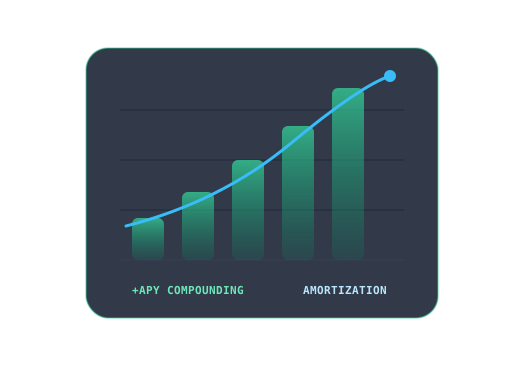
Compound Interest Calculator
Project savings growth from an initial principal, nominal annual rate, compounding frequency, and recurring contributions.
Compound Interest Calculator Interactive Calculator & Breakdown
$54,713.58
Total Deposits: $34,000.00 • Total Interest: $20,713.58 • Effective APY: 7.229%
| Item / Metric | Calculated Value |
|---|---|
| Initial Principal | $10,000.00 |
| Total Recurring Deposits | $24,000.00 |
| Compound Interest Earned | $20,713.58 |
| Effective Annual Yield (APY) | 7.23 % |
Active Calculation Steps & Disclosed Assumptions
Formula v1.0.0Live Formula Evaluation:
- • Effective Annual Rate = (1 + 0.07/12)^12 − 1 = 7.229%
- • Total Contributions = $34,000.00; Compound Interest = $20,713.58
Assumptions Applied:
- Nominal rate 7% compounded 12x/year (Effective APY: 7.229%).
- Contributions applied at the end of each month.
Discrete Compound Growth with Periodic Contributions
For nominal rate r, compounding frequency n per year, and t years: Effective Annual Rate = (1 + r/n)^n − 1. Period-by-period simulation applies contribution at either the beginning (annuity due) or end (ordinary annuity) of each period and compounds at rate r/n.
Worked Example: $10,000 Initial Deposit + $200/Month at 7% Compounded Monthly for 10 Years
End-of-period monthly contributions over 120 months.
Sample Inputs
- Initial Principal: $10,000
- Nominal Annual Rate: 7.0%
- Compounding: Monthly (12/yr)
- Monthly Contribution: $200 (End of Period), Years: 10
Calculation Steps
- Initial $10,000 grows to $10,000 × (1 + 0.07/12)^120 = $20,096.61
- 120 monthly contributions of $200 grow to $34,616.96
- Total Contributed = $10,000 + $24,000 = $34,000.00
Example Result: Final Balance: $54,713.57 ($34,000 total deposits + $20,713.57 compound interest).
Support
Frequently Asked Questions
Quick answers about how this works, what it assumes, and where its limits are.
What is the difference between Nominal Rate and Effective Annual Rate (APY)?
The nominal rate is the stated annual rate before compounding within the year. Effective Annual Rate (APY) reflects intra-year compounding: (1 + r/n)^n − 1.
How does contribution timing (Beginning vs. End of Period) affect the total?
Beginning-of-period deposits earn one extra compounding period of interest on every contribution compared to end-of-period deposits.
Keep going
Related tools, calculators & guides
CSV ↔ JSON & Color Format Converter
Convert between CSV and JSON datasets with quoted-field support and instant file download.
PDF Merger
Combine multiple PDF documents in custom order with optional per-file page ranges while preserving crisp vector text.
Images to PDF Converter
Combine multiple PNG, JPG, or WebP images into a clean, multi-page PDF document on-device.
Loan Calculator
Calculate periodic loan payments, total interest, payoff schedule, and extra payment savings.
Mortgage Calculator
Break down monthly mortgage principal & interest alongside property taxes, homeowners insurance, and HOA fees.
Percentage Calculator
Calculate percentages of numbers, ratios as percentages, and percentage increases or decreases.

Loan Amortization Formulas, Mortgage PITI Escrow & Nominal vs. Compound APY
Understand the exact annuity equation behind level loan payments, how extra principal payments cut lifetime interest, why escrow stays separate from P&I, and APR vs. effective APY.